My “non-chlorine” experiment and why I switched back to dichlor
When we bought our Softub Portico, I knew one thing for sure: The tub itself is the easy part. The real long-term experience (good or bad) is determined by water maintenance. And yes, I’m one of those people who enjoy systems that can be measured, controlled, and kept stable.
Softub ships with their own recommended water care kit and process. It works. But after a while I started wondering: Can I do better?
My motivation and why I decided to complicate my life
The original Softub approach is based on dichlor (sodium dichloroisocyanurate, also labeled as troclosene sodium dihydrate). It is effective, measurable, and generally simple. However:
- I never loved the chlorine smell right after dosing, even if it fades later
- I hoped for something that feels a bit more “modern” and less noticeable
- I wanted a system that might be less irritating for skin/eyes in a hot tub where jets create spray and you breathe it
That’s how I ended up trying a “chlorine-free” approach. I tried products from Krystalpool, but this is not Krystalpool-specific. The same chemistry exists under many brands. I chose this one because it is widely available in local shops here.
Chlorine vs. Dichlor vs. Trichlor – what’s the difference?
When people hear “chlorine,” they often imagine liquid bleach used in public pools or household cleaners. In reality, dichlor is simply a stabilized form of chlorine designed specifically for pool and spa use.
- Liquid chlorine (sodium hypochlorite) is highly alkaline and commonly used in large public pools.
- Dichlor (sodium dichloroisocyanurate) is granular, stabilized, and closer to neutral in pH.
- Trichlor (trichloroisocyanuric acid) is typically sold as slow-dissolving tablets. It is strongly acidic and continuously adds stabilizer (cyanuric acid) to the water. Because of its low pH and tablet delivery method, it is generally not suitable for small vinyl-lined hot tubs like Softub.
Once dissolved, all three forms ultimately produce the same active disinfectant: hypochlorous acid. The difference lies in delivery form, pH impact, and stabilization behavior, not in the underlying disinfecting mechanism itself.
The “non-chlorine” setup I ran
My experiment lasted a couple of months and looked like this:
1) PHMG / PHMB + BAC disinfectant
This is what many shops sell as a “chlorine-free shock” or “chlorine-free disinfection”.
- PHMG/PHMB = biguanide disinfectant (long lasting residual)
- BAC = quaternary ammonium compound (benzalkonium chloride), often present in small % as support
In my case it was Krystalpool Bezchlorový šok (liquid), Similar PHMB-based systems are sold under various pool brands internationally.
2) Oxygen-based oxidizer (percarbonate or persulfate)
Used to oxidize organic contaminants because biguanide itself is not a strong oxidizer.
Common forms:
- Sodium percarbonate (releases hydrogen peroxide)
- Potassium peroxymonosulfate (non-chlorine shock / MPS)
- In my case: Krystalpool OXI granules
3) Clarifier / flocculant (PAC-based)
Clarifier/flocculant (PAC – polyaluminum chloride type chemistry).
- Purpose: water clarity, better filtration of very fine particles
- In my case: Krystalpool Jiskra (liquid)
On paper it sounded good: disinfect with biguanide, oxidize with peroxide, keep water crystal clear with a clarifier. I also heard great reference from pool owners, so after some research to understand the impact for vinyl liner (to not damage it) and to Softub in general, I prepared for the switch.
Hopes vs. reality (what I expected and what I got)
What I hoped for
- Less chlorine smell (especially after dosing)
- Less irritation for skin/eyes
- “Cleaner” feeling in general
- Less maintenance (or at least “simpler maintenance”)
What actually happened
And here comes the honest part. This is based purely on my personal experience and my own attempt.
1) The smell was not better
Yes, the water was not “pool-chlorine-smelly”. But it developed a different smell that I can only describe as plastic cable / cheap toy / chemical smell
It’s persistent and sits in your nose. With dichlor the smell is often strongest right after dosing (when nobody is inside), then it settles down to a mild “clean water” smell. With PHMG/BAC this smell was always there.
So in the end I actually preferred the chlorine smell.
2) More chemicals, more routines
With dichlor, the treatment routine is simpler, because you:
- keep free chlorine in range
- adjust pH occasionally
- shock sometimes
With PHMG/BAC the system becomes multi-variable:
- disinfectant dose schedule
- OXI schedule
- clarifier schedule
- plus pH- corrections (more on that next)
It worked, but it was more operational overhead. But I would still accept that routine, if…
3) pH stability was worse (and this really annoyed me)
This one surprised me the most. With dichlor, pH felt “naturally stable” in Softub. The tub use (aeration + bather load tends to raise pH) and dichlor dosing (slightly acidic) acted as a counterweight. I rarely had to fight pH aggressively.
With PHMG + OXI on the other hand the pH kept drifting upward. I was adding pH- regularly. Very regularly, including precise pH monitoring.
So I looked into why this was happening and found that it’s simply the chemistry:
- OXI (percarbonate) leaves carbonate, which pushes pH up
- PHMG/BAC is roughly pH-neutral
- bathers + aeration also push pH up
=> there is no built-in counterweight. The more people used the tub, the more I had to add pH minus.
4) The liner started turning slightly yellowish
Not dramatic, but visible. Especially in areas above waterline / around the cover fold zone. Did I destroy the liner? No. But it was one more thing that didn’t happen with dichlor.
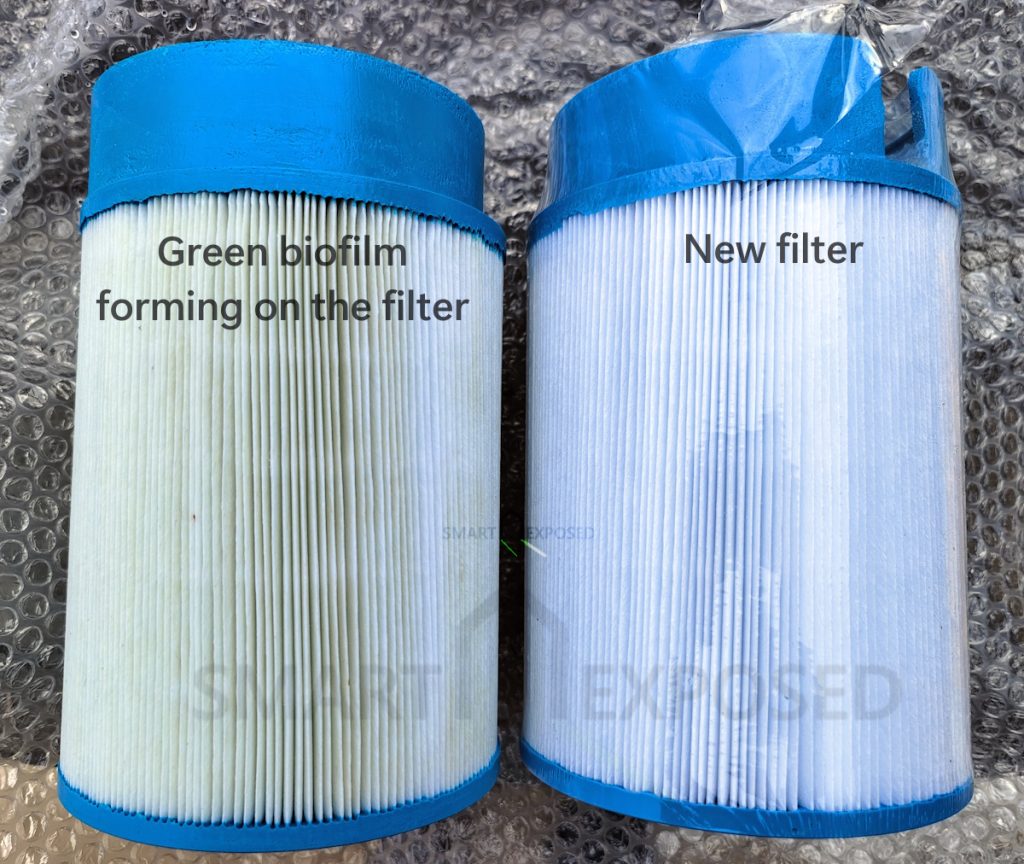
5) Filter got a green biofilm
This was a big “ok this is not great” moment. The white filter paper showed a green film layer. It rinsed off easily with a hose, but it tells you something important:
If it can grow on the filter, it can probably grow in low-flow places in plumbing too.
With dichlor I only saw anything similar when I was lazy with dosing (which is the whole point: chlorine gives you margin).
6) Filter cleaning became harder
With dichlor, you can use common chlorine-based disinfectants available everywhere (e.g. Savo) to sanitize and restore your filter cartridge (with proper rinsing and common sense).
With PHMG/biguanide systems, chlorine cleaning is a no-go. It’s simply not a friendly combination. So my “easy and cheap maintenance trick” disappeared.
7) Mold started forming on the inside of the thermal cover
This one surprised me, but it makes sense in retrospect. The thermal cover interior is warm and humid, and the air above the water is in contact with condensed droplets. With chlorine systems, a mild oxidative effect is present even in the airspace above the water. With PHMG (which is non-volatile), there is essentially none.
Result: early signs of black mold on the inside of the cover. That was new.
The funny part: the system did stabilize (but I still wasn’t happy)
To be fair: after some time, the PHMG system “calmed down”:
- water was visually perfect
- the slimy feel disappeared
- routine dosages were enough
So yes, it can work.
But it never became the “more pleasant” system I hoped for, because my main pain points remained:
- persistent smell
- constant pH corrections
- biological hints (filter film, cover mold)
- liner tint
Measurement difficulty of non-chlorine chemistry
One practical limitation of non-chlorine chemistry is measurement. Chlorine and bromine levels are easy to verify using inexpensive test strips or photometers, which makes day-to-day control relatively straightforward and predictable. Biguanide and peroxide-based systems, on the other hand, require specific test kits that are harder to obtain and often less precise. In practice this makes it much more difficult to know whether the water is correctly dosed, under-dosed, or already overdosed.
This difference in measurability has a surprisingly large impact on long-term comfort and maintenance. Being able to quickly confirm sanitizer levels with a simple strip is one of the reasons chlorine and bromine systems feel more controllable in everyday use, while biguanide-based approaches rely more on routine dosing schedules and visual inspection rather than direct measurement.
Decision: back to dichlor (local replacement)
So I decided to return to what worked best for us: dichlor.
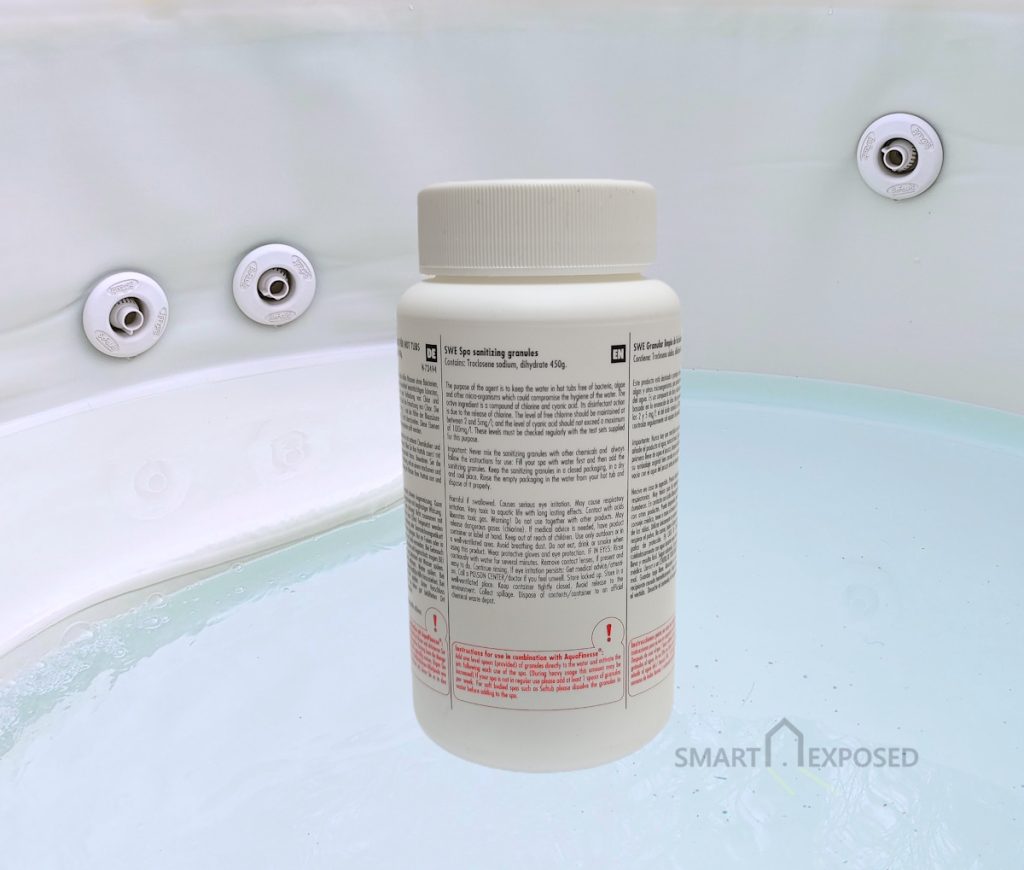
I wanted a local equivalent of Softub’s original chlorine product. Good news: it exists and it’s the same chemistry. I’m using:
Krystalpool Chlor Šok (SDIC)
Active substance: dichloroisokyanurát sodný, dihydrát (available chlorine ~54.5%).
PDF: (link)
That’s the same class of product as typical spa dichlor. It’s marketed for pools, but chemically it’s standard spa dichlor.
My reset procedure
- drained the tub completely
- cleaned the liner
- replaced filter cartridge with a new one
- refilled with fresh water
- dosed dichlor (SDIC) as the new baseline
I’m expecting that the first week will have higher chlorine demand as the system cleans residues (normal after PHMG), but after that the maintenance should return to the “easy mode” I remember.
Summary: a quick pros/cons table
PHMG/BAC + OXI
- ✅ clear water once stabilized
- ✅ no “chlorine pool smell”
- ❌ persistent plastic/vinyl odor (for me)
- ❌ frequent pH- corrections
- ❌ filter biofilm hints / cover mold risk
- ❌ harder filter sanitation
Dichlor (SDIC)
- ✅ measurable free chlorine
- ✅ pH tends to be stable
- ✅ cleans surfaces + airspace better
- ✅ simple routine
- ⚠️ smell right after dosing (but predictable and temporary)
And how about bromine?
I also briefly considered bromine-based treatments, which are often presented as a modern and premium option for whirlpools. Bromine is widely used in many classic acrylic spas and is frequently recommended for hot water environments. Chemically, it is not weaker than chlorine. In elevated temperatures it remains stable, tolerates slightly higher pH levels, and many users describe its odor as milder than traditional chlorine.
Unlike chlorine, however, most residential bromine systems operate as a two-step process. First, a sodium bromide “bromide bank” is established in the water. Then an oxidizer (such as chlorine or non-chlorine shock) converts those bromide ions into active hypobromous acid, which is the actual disinfectant. Without first establishing this bromide reserve, simply adding bromine tablets can result in unstable or misleading sanitizer readings. This additional layer of chemistry makes bromine systems somewhat more complex to understand and control compared to directly dosing dichlor and measuring free chlorine. Detailed explanations of this mechanism can be found in resources such as Leslie’s Pool guide to brominating a spa or InTheSwim’s explanation of building a bromine bank.
When evaluating bromine specifically for Softub, additional practical considerations appear. Most bromine systems rely on slow-dissolving tablets placed in floating dispensers or inline erosion feeders. Softub, with its vinyl liner and without a dedicated feeder system, is not ideally designed for floating tablet chemistry. Local concentration around a tablet or dispenser can stress vinyl surfaces if not carefully managed.
Bromine is also less volatile than chlorine. While this may reduce sharp odor, it also means there is less oxidative effect in the airspace under the thermal cover. In a constantly warm and humid environment, that mild airspace oxidation can contribute to suppressing mold formation.
Interestingly, Softub’s own water treatment guide explicitly recommends granular chlorine (dichlor) and states that the use of bromine is not recommended and may void the warranty. While this does not mean bromine is inherently unsafe, it does suggest that the system was engineered and validated around stabilized chlorine chemistry rather than tablet-based bromine systems.
From a purely chemical standpoint, bromine remains a technically valid spa sanitizer, and many users report good long-term results in conventional hot tubs. In the specific design context of Softub, however, it is not clearly simpler or more robust than dichlor, and may introduce additional handling considerations. For those reasons, I ultimately did not run a long-term bromine setup myself.
If you have real-world experience with bromine in a Softub, I would genuinely be interested to hear your observations in the comments.
Softub is not a typical whirlpool (and why that matters for chemistry)
One important realization during this whole experiment was that a Softub is not a typical whirlpool, and that difference has direct impact on water chemistry decisions.
Classic acrylic hot tubs usually rely on powerful circulation pumps, strong electric heaters, and often additional sanitation support such as ozone or UV. High flow rates, aggressive filtration, and rapid thermal turnover create an environment where many different chemical systems can work reliably.
Softub follows a very different philosophy. The system is extremely energy-efficient, with excellent insulation and no dedicated heating element. Almost all electrical energy ends up as heat in the circulating water, which is elegant from an efficiency perspective, but it also means lower circulation power, slower warm-up, and generally gentler hydraulic conditions inside the plumbing.
Temperature plays an equally important role. Most pool chemistry guidance assumes water below 30 °C. A hot tub operating continuously at 38–40 °C is a fundamentally different chemical environment: Reactions accelerate, disinfectants decay faster, and biological growth becomes more aggressive. Something that behaves perfectly in a swimming pool does not automatically behave the same way in a hot tub.
These physical and thermal differences matter. In a low-flow, constantly warm environment without strong auxiliary sanitation, the disinfectant must prioritize robustness, measurability, and the ability to control biological growth even in places where water movement is limited.
Many products marketed as “whirlpool chemistry” are designed and validated primarily for classic acrylic spas with much stronger circulation and additional sanitation technologies. What works reliably there does not necessarily translate to Softub conditions.
Looking back, this context explains much of my own journey. Multi-component systems that rely on precise balance between several chemicals (such as biguanide with peroxide and clarifier) are inherently more sensitive to hydraulic and thermal limits. Simpler halogen-based sanitation, even if less fashionable, tends to be more tolerant of the specific physics Softub is built around.
What I learned (and what I’d recommend)
The most important lesson from this experiment is that water chemistry cannot be evaluated in isolation from the physical design of the tub. Softub’s low circulation, constant high temperature, vinyl liner, and absence of auxiliary sanitation place very specific demands on the disinfectant system.
In that environment, robustness and measurability matter more than marketing promises about being “chlorine-free” or “more modern.”
Based on real-world operation, biguanide-based systems (PHMG + oxidizer + clarifier) are simply not a good match for Softub physics. They can be made to work, but require more intervention, provide less measurable control, and show earlier biological and cosmetic side effects.
Halogen-based sanitation remains fundamentally more tolerant of these constraints. Bromine is a technically valid alternative and widely used in hot spas, but it is not clearly simpler or more robust in the specific Softub environment.
For that reason, returning to dichlor was not a nostalgic choice but a practical one. It provides the most predictable balance of sanitation strength, measurability, material compatibility, and maintenance simplicity for this particular type of tub.
In the end, the experiment still served its purpose. It replaced assumptions with real experience and clarified not only what works, but also why it works in the specific conditions Softub creates.
Quick comparison
After testing two of the chemistries in real use and reviewing available information about the third (Bromine), it felt useful to summarize the day-to-day behavior in a simple comparison. The table below is not a laboratory evaluation or universal recommendation, but a practical reflection of operating a small hot tub at around 38–40 °C, where correct maintenance often matters more than the specific product used.
| Option | Smell | Feel | pH | Measurement | Maintenance | Liner impact |
|---|---|---|---|---|---|---|
| PHMG + OXI | ❌ persistent | ⚠️ variable | ❌ rising | ❌ difficult | ❌ frequent | ⚠️ yellowing risk |
| Bromine | ⚠️ mild | ✅ clean | ⚠️ tolerant | ✅ easy | ⚠️ moderate | ⚠️ delivery-sensitive |
| Dichlor | ⚠️ short-lived | ✅ clean | ✅ stable | ✅ easy | ✅ simple | ✅ long track record |
The additional “material compatibility” column reflects practical long-term observations from spa use rather than short laboratory exposure. Real-world material compatibility depends on maintenance quality, water balance, and specific product formulation, not only on the sanitizer type itself.
For now I have returned to the simpler dichlor-based approach because of its stability and straightforward control. But if you have long-term success with bromine or another method, I would genuinely be interested to hear about your experience.
Quick update (the result)
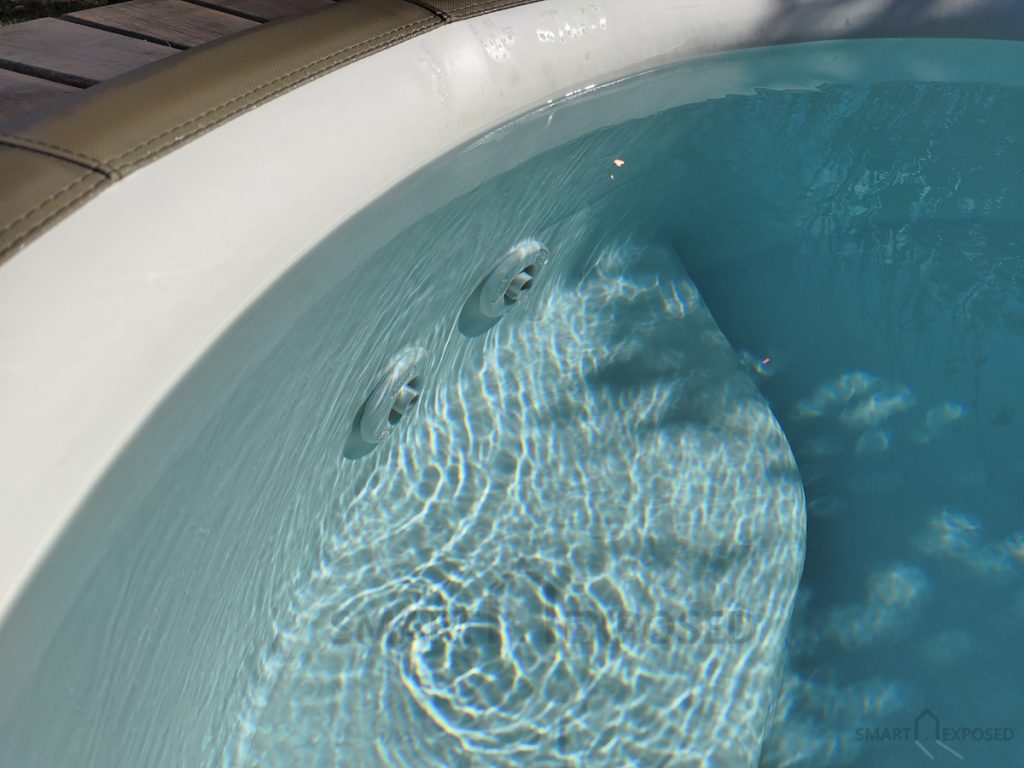
After switching back to dichlor and letting the system run normally for a short while, I checked the Softub liner again, and the result genuinely surprised me.
The yellowish stains that appeared during the PHMG + BAC period are completely gone. The liner looks factory-new again, despite the tub being three years old.
This was not achieved by aggressive cleaning or special treatments, just normal dichlor operation. Given how quickly the discoloration appeared during the biguanide phase, I was honestly worried it might be permanent. It wasn’t. I am happy to see that stabilized chlorine (dichlor) is not only easier to control, but also far more forgiving, and even restorative, for Softub materials over time.
Read more about Softub
What could we do better?