
Somewhere in a cabinet, a drawer, or a rack, there is a piece of consumer electronics that still works. It powers on. It still does the thing it was bought to do. Its capacitors and connectors are perfectly healthy. And yet it is finished. Not broken. Not worn out. Simply no longer allowed to become anything more than it already is. That’s a stranger kind of obsolescence than the one we’re used to talking about, and the real question isn’t whether it’s happening. It’s who decided, why they were allowed to, and how much further into ordinary life that decision is about to reach.
The frozen stack
Mine is a set-top box: a VU+ Solo 4K, running a community-maintained build of Enigma2, the open-source software most European satellite receivers of the last two decades have been built on. The Solo 4K was not some disposable 30 EUR streaming dongle. It was a fairly sophisticated enthusiast receiver. It has an ARM SoC, 2 GB of RAM, eMMC storage, 4K/H.265 capability, FBC satellite tuning, a front-panel display, and an internal HDD. It still tunes satellite and terrestrial broadcast. It still drives a small color front-panel display. It still runs a genuinely scriptable Linux underneath, with a plugin system open enough that I’ve written my own small tools for it. None of that has stopped working. What stopped is everything downstream of one chip.
The usual story of a gadget’s death is a physical one. A battery that no longer holds charge, a hinge that snaps, a drum or a head that’s spun past its rated cycles. Replace the part, or don’t, and the story ends there. But an enormous amount of what actually runs a modern device isn’t hardware at all. It’s a tower of software sitting on top of it, and increasingly that tower is what dies first while the hardware just keeps watching.
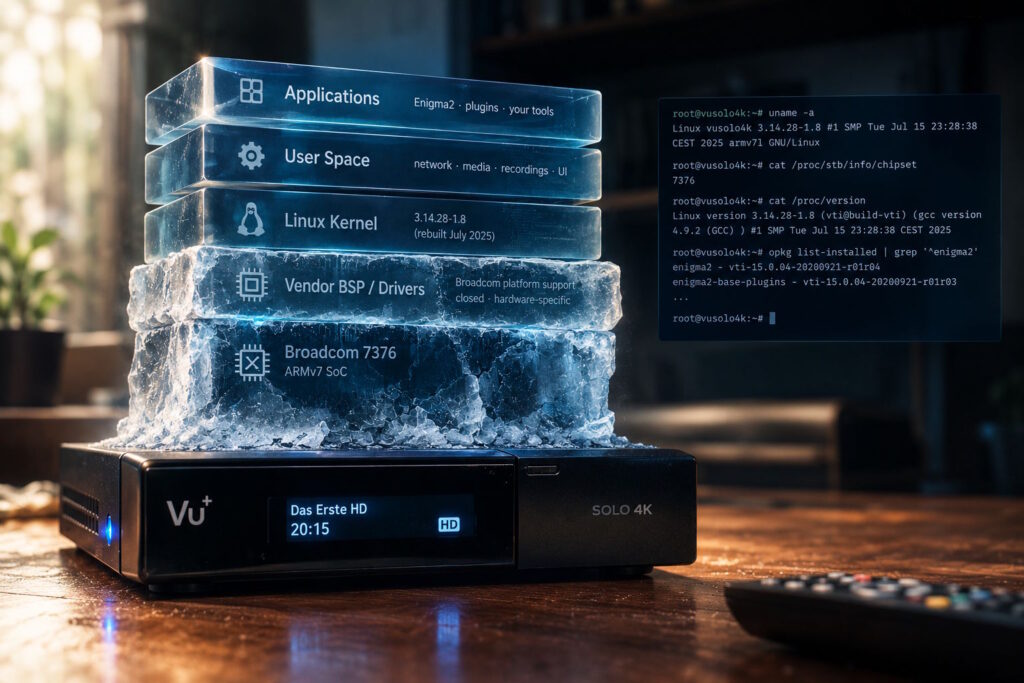
Underneath the visible operating system of many embedded devices sits a much older, much less visible layer: the vendor BSP and its hardware drivers, usually supplied as sealed binaries, written by whoever made the chip to talk to that chip’s specific registers, memory controller, and, on anything that plays video, its decoder. In my box’s case, the community can keep rebuilding the software above it, but the machine is still anchored to a vendor BSP and a Linux 3.14-era kernel from 2014. That lower layer contains proprietary components the community cannot simply replace or recompile, so the operating system can evolve only within the boundaries the original hardware platform allows.
For those proprietary components, there’s no source to recompile and no community patch to apply. They are part of the vendor’s binary platform support, and once that support stops moving, everything above it inherits the boundary.
There’s no source to recompile and no patch to apply, because the chipmaker never meant for anyone downstream to touch it. So the device’s actual operating system quietly stops moving, sometimes a full decade before the plastic around it does.
This isn’t really a software bug. It’s closer to a geological layer, laid down once at the moment the chip shipped and never disturbed again. Which raises the obvious question: who laid it down that way, and did they have to?
A wall with a reason
It would be easy to call this laziness or greed and leave it there, but a good part of it genuinely isn’t optional for the manufacturer. For many forms of licensed video, the protected part of the decode path has to run inside a closed, audited environment on approved hardware, because the rights-holder’s security model assumes that an inspectable path is an extractable one. Open the source and you haven’t just opened a driver. By the industry’s own threat model, you’ve published a way to pull the decrypted picture straight out of memory.
It’s worth saying this kind of gate isn’t always so total. I still use an old Sony SACD player, a DVP-NS930V, and there’s a relay inside that audibly clicks whenever it switches into SACD mode. I used to assume that click was the copy protection itself, physically cutting the digital output. It probably isn’t, or not directly: the actual block on getting a high-resolution digital signal off an SACD happens at the software/hw level inside the player, and as far as I’ve been able to find, there’s no clean way around it on this hardware. So this particular restriction is real, and unlike most of the DRM in this piece, it seems to have actually held. What makes it tolerable anyway is that it’s narrow: the player still plays every disc perfectly over its analogue outputs, which is arguably the only output SACD was ever going to need, since piracy was never really the point of owning one. That’s the version of DRM the industry could have built everywhere: a single capability withheld, not a whole device’s future. Video decoding got the other version instead.

So the closed layer around video decoding isn’t an accident of corporate culture. It’s a gate, built to a specification the manufacturer didn’t write and can’t unilaterally open, even for hardware it no longer sells. That’s a genuinely different force than “we didn’t feel like it,” and if it were the whole explanation, this would be a closed case: nobody’s fault, nothing to be done. It isn’t the whole explanation, though, because the same industry that insists this gate must exist has, at almost every other layer of computing, built no such gate at all.
The blast radius
The important distinction is that DRM can explain why some parts of a video path have to remain closed. It does not explain why everything around those parts has to age with them. A secure decoder can be proprietary while the operating system around it continues to receive updates. Drivers that don’t touch the protected path can remain open. User-space software can evolve. Interfaces can stay documented. None of that requires handing the decrypted picture to whoever wants to inspect the source.
The problem begins when the boundary gets drawn around the whole platform instead of the part that actually needs protecting. A locked decoder is one thing. A locked operating system is another. Once the two become inseparable, a security requirement imposed on one component becomes a retirement date for everything attached to it.
It’s the difference between locking one room and building the entire house so nobody can renovate it.
Where the gate doesn’t stand
Most of computing didn’t go this way. Server rooms, cloud infrastructure, the hobbyist single-board-computer world, all of it runs almost without contest now on fully open software, updated for as long as anyone cares to bother, on hardware that regularly outlives its original job by simply finding a new one. The difference was never really about ideology. It came down to who was buying, and how much leverage that buyer actually had.
A large enterprise buyer can put openness, source access, long-term support or interoperability into a procurement contract and make it somebody else’s problem if the vendor refuses. A household buying one set-top box has no equivalent bargaining position. Openness turns out not to be something manufacturers hand out because they believe in it. It’s a term that gets negotiated, and it tends to show up where somebody with real weight sits down at the table and asks for it.
So the certification regime from the last section isn’t an immovable law of physics. It’s a rule that consumers have almost no standing to negotiate around. Which raises the next question: how much did that rule actually deserve, in the first place, all the deference it’s been given?
A lock that keeps getting picked
Not much, as it turns out. The awkward part of the content-protection argument is that these systems have never remained effective against determined attackers for very long. DVD’s copy protection was cracked within about a year of the format’s release, by a Norwegian teenager working with two anonymous collaborators, and has been treated as a formality ever since.1 HDCP’s master key leaked in 2010, and because it’s burned into hardware already sold, it can never really be revoked.2 Almost every anti-tamper layer that has mattered at consumer scale has eventually been bypassed by someone.
What that track record suggests is that these systems were never actually built to stop a determined adversary. Nothing has managed that for long. What they certainly can do is raise the cost of casual copying for the average person, while permanently loading their real cost onto every legitimate owner instead: the sealed chip, the frozen kernel, the device that can never be extended past the day it shipped. The protection is temporary. The debt it leaves behind isn’t.
None of that has stopped the industry from doubling down on the same bet, chip after chip, decade after decade. It’s worth asking why a strategy with this consistent a failure rate keeps getting chosen anyway. History already ran that experiment more than once, with the same company holding the losing hand each time.
The company that keeps losing this way
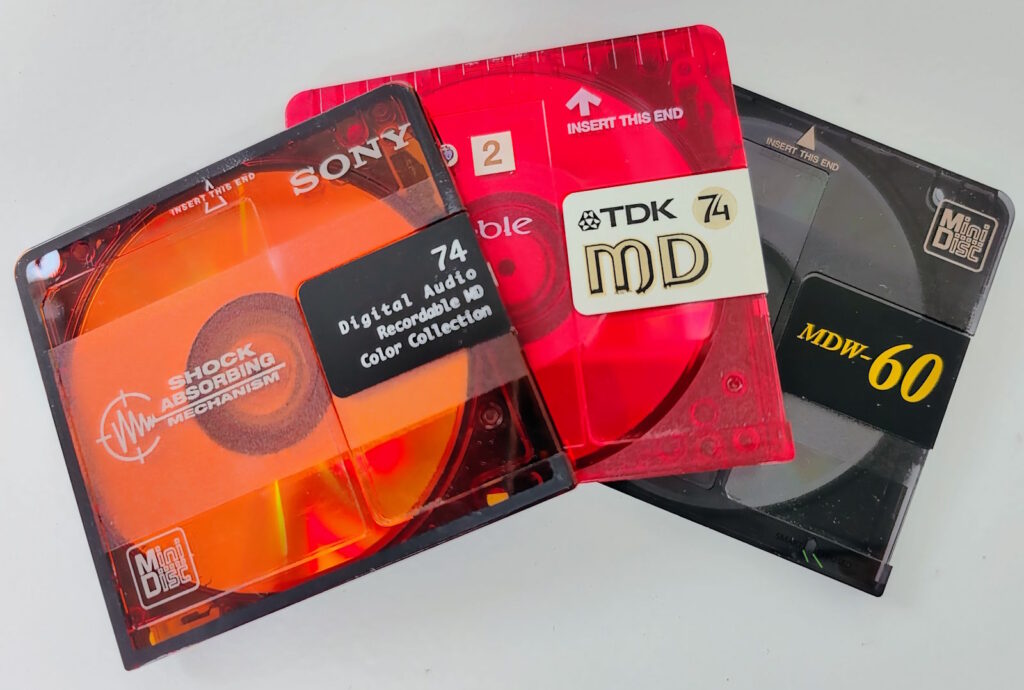
There’s a pattern in electronics history worth knowing, because one company keeps demonstrating it against itself. Sony’s Betamax lost the home-video format war to VHS partly because Sony kept licensing tight while JVC licensed VHS generously to more manufacturers, more cheaply.3 Decades later, Sony’s own recordable MiniDisc format wrapped digital copying in restrictions strict enough to frustrate the very customers it needed, and lost the portable-audio era to formats that simply let people move their own files around: first MP3, later a more permissive but still walled alternative.4 Tight control, applied to protect a business, has a documented habit of costing that business the market instead.
That lesson only really bites the company that learns it the hard way, though. It does nothing for the customer already holding the format that lost, and it’s worth being precise about which kind of control actually did the damage there, because not every case in this piece is the same shape.
The trick with no alibi
It’s worth separating the licensing-driven kind of obsolescence from its blunter, more deliberate cousin, because people tend to lump them together and they aren’t quite the same thing. HP pushed a firmware update in 2020 that made some printers reject perfectly good third-party ink, throwing an error claiming the cartridge was damaged when it wasn’t. It cost the company a class-action settlement approved by a federal judge in 2025.5 Some Canon all-in-one printers have been reported, and separately sued over, refusing to scan or fax once their ink runs low, an operation that uses no ink or toner at all.6
There is no content industry, rights-holder or external certification body demanding any of that. The restriction is imposed by the manufacturer itself, and its commercial effect is obvious: it makes a working printer less useful unless the owner buys the manufacturer’s consumables.

Which paradoxically makes it the easier fight to challenge: a regulator or a court can confront a manufacturer directly when the restriction comes entirely from the manufacturer’s own design, rather than from somebody else’s security requirement. That’s probably why the printer fight has produced real settlements and real scrutiny, while the licensing-driven version of the same outcome remains almost untouched by comparison. Both can end with a working device in a landfill. The difference is that one gives a regulator an obvious manufacturer to confront, while the other can be defended as somebody else’s security requirement. It doesn’t need a villain to keep spreading.
Where this stops being a hobby
Because it is spreading, well past the objects this piece has been about so far. A modern car can contain hardware capable of doing something the owner has already physically bought, while software decides whether the owner is currently entitled to use it.
Farm equipment has become one of the most litigated fronts in the whole right-to-repair movement. For years, a tractor with a blown sensor could refuse a farmer’s own diagnosis, mid-harvest, until an authorized dealer arrived with a manufacturer-only tool.
In 2026, the Federal Trade Commission and five states reached a settlement with John Deere requiring the company to make the same applicable repair resources and software capabilities available to farmers and independent repair providers that it provides to authorized dealers.7 None of that is a satellite receiver or an inkjet cartridge. It’s the equipment somebody’s whole livelihood depends on, gated by the exact same logic, because that logic worked the first hundred times nobody with real leverage pushed back. The lock wasn’t imaginary. Someone just finally got enough leverage to make the owner hold the key.
That’s the trajectory worth paying attention to. This pattern didn’t stay confined to the categories where it was easiest to shrug off. It moved toward wherever a chip could be put, because a chip is now cheap enough to put anywhere, and a subscription toggle is cheaper still. Left alone, the working-but-finished object stops being an oddity in a hobbyist’s cabinet and becomes the default condition of anything with a battery or a firmware update, including the things nobody actually gets to do without.

The gap in the repair movement
The growing push toward repairable, longer-lived electronics (replaceable batteries, published spare-parts lists, repairability scores stamped on the box) is aimed almost entirely at physical failure. It has very little to say about a device whose hardware is demonstrably fine and whose software simply isn’t allowed to go any further. There’s no screwdriver for that kind of obsolescence, no spare part that fixes it, because nothing in it is actually broken. The device gets retired not because it failed, but because a licensing regime, negotiated years earlier by people who never met whoever’s now holding the device, decided it should stop being extensible.
That’s arguably the more wasteful failure mode of the two, not the less. A battery can be swapped by a determined owner with a guide and a spudger. A decade-frozen, DRM-sealed decoder can’t be fixed by anyone, at any skill level, no matter how much they want to try. Right-to-repair policy hasn’t caught up to that distinction yet. It’s still measuring obsolescence in cracked screens and dead batteries, in a world where a growing share of it now arrives as a clause in a contract nobody in the room actually signed.
What actually lasts
Not everything ages this badly, and it’s worth ending on the counterexample rather than just the warning. I still run a Sony PS-X600 turntable from the early eighties, long out of production, and the only thing I’ve ever needed to replace on it is the stylus. I recently swapped its old Excel MC-100E cartridge for a new Hana SH, a completely different manufacturer, made decades later, and it simply worked, because a phono cartridge is a mechanical and electrical standard, not a licensed one. Nobody had to approve the swap. No firmware checked whether the new part was genuine. I still buy new vinyl for it now and then, pressed by labels that didn’t exist when the turntable was built, for a format that was never given a reason to gate it.

That’s the quiet argument for the other path. A machine that doesn’t need anyone’s permission to keep working simply keeps working, for as long as someone’s willing to maintain it, decades past whatever its original manufacturer expected. Nothing about the chips inside a set-top box makes that outcome physically impossible. The difference is whether the design leaves the owner with a machine, or with a machine whose future still belongs to someone else.
Every case in this piece resolves to the same question, asked of a different object each time: who was sitting at the table when the rule got made, and could they have simply said no and walked away? Governments can. Cloud buyers can. A household with one set-top box, one printer, one car, can’t, not alone.
Whether it stays that way isn’t really a technology question. It’s a question of whether anyone with the standing to say no shows up before the rule finishes writing itself into everything else.
References:
- DeCSS, Wikipedia. en.wikipedia.org/wiki/DeCSS
- “Understanding the HDCP Master Key Leak,” CITP, Princeton University, 2010. blog.citp.princeton.edu
- “VHS vs Betamax: Standard Format War,” ANSI Blog. blog.ansi.org
- “6 Discontinued Sony Formats (And Why They Failed),” SlashGear. slashgear.com, and also MD Data, Wikipedia. en.wikipedia.org/wiki/MD_Data
- “HP settles lawsuit over ink-blocking printer update,” TechSpot, 2025. techspot.com
- “Some Canon printers are reportedly being bricked after running out of ink,” TechRadar. techradar.com
- “FTC, States Secure Settlement with Deere & Company, Advancing Farmers’ Right to Repair,” Federal Trade Commission, 2026. ftc.gov
What could we do better?